
Race, Identity & the Writer's Craft
Building Social Trust Between Black and White Women
Deborah Plummer

Do We Need a Form of Couples Therapy to Achieve Racial Equity?
As a young psychologist facilitating couples therapy, I quickly learned that it was easy to become the enemy of one partner simply by agreeing with the other partner. This pattern would set up a dynamic of “therapist volleyball” where I was tossed as the enemy between one or the other partner in any given session based on which partner I appeared to be favoring with my response.
As a seasoned psychologist, I learned to ward off this volleying and cries of “you always agree with her or him,” by creating an imaginary fourth person in the room called Goal. In our initial session, I would work with the couple to clearly define the goal (repairing the relationship or amicably ending the relationship, or getting clarity on what direction was needed, are examples). Once the goal was determined, I assured them that if I appeared to favor one partner over the other, it was because what that partner was saying or doing was in service of the goal. I really wasn’t an enemy to either of them. I was just in agreement with Goal, the invisible fourth person in the room.
The Women’s Marches, #MeToo Movement, and “New Class of Badasses in Congress,” and the 2016 and 2020 voting patterns have exposed both the unifying and dividing factors between White women and Women of Color. It has further deepened the historical divide between White and Black women, the top and bottom of America’s hidden caste system, necessitating a kind of group couples therapy.
In our group identities as Black and White women we have to intentionally decide how to repair our relationship, or choose if we will just tolerate each others’ existence in a civil manner until the end of time.
Black and White women enjoy many wonderful cross-racial friendships that are characterized by trust. Yet, that trust remains on an interpersonal level and doesn’t necessarily get transferred to the group identity level, especially when it comes to Black women trusting White women. How interpersonal trust gets transferred to social group identity is a mix of many factors: confidence in institutional government, age, race, ethnicity, gender, socioeconomic factors, education, to name a few.
No matter what the presenting concerns are that bring a couple to therapy, trust becomes a key factor to explore. Similarly, in our group identities, enhancing social trust is a critical factor to lessening the historical divide between Black and White women. There are a number of reasons why social trust doesn’t exist between Black and White women and why relationship building is necessary to make significant progress toward racial equity. Because of that, social trust among Black and White women is worth exploring.
What is Social Trust?
In our project to enhance social trust among Black and White women, we’ve defined social trust as both an emotion and a choice. As an emotion, it is a feeling of benevolence, compassion, and caring for each other in our racial identity groups. As a choice, it is a belief that the other racial group is honest and fair and that they will show up for us and have our back in a consistent manner on issues that matter.
Black women report that a high level of trust they may hold with an individual White woman friend does not transfer to White women in general. White women, as a group, are not trusted by Black women. White women bosses rank as the least trustworthy.
White women report that their high levels of trust with a Black woman friend does better position them to collectively trust all Black women, but they do so with caution. This caution, in some cases, came after learning an embarrassing but enlightening lesson about white racial identity.
Reasons for Lack of Social Trust
A root cause analysis of social mistrust between Black and White women leads to many factors. Each factor is an essay (or book) on its own, but I will just list them here:
- Historical Baggage (slavery, Jim Crow)
- Current Day Racial Discrimination (wealth, health, voting rights, education, housing segregation, criminal justice system)
- Stereotypes and Controlling Images in the Media (Karens vs. Angry Black Women tropes)
- Disparate Racial Treatment of Gender Discrimination and Harassment by Men
- White identity that allows White women to choose racial privilege over gender solidarity
- Family Socialization Process, especially when socioeconomic class is considered
- Faith Traditions/ Religious Beliefs that promote systemic racism
- Competition Over Sex/Love Partners
As with many couples, especially those in a long-term relationship, one partner may be acutely aware that the relationship is falling apart while the other partner happily lives in the land of clueless. That is the case for the historical and present-day relationship between Black and White women. Especially over the past several years, Black women report that when it comes to importance of racial equity, they are the explainers, arbitrators, comforters, problem solvers, and solution implementers, while many White women are just responding to their wake up call, some do not even hear the phone ringing, and some have conveniently placed themselves no where near their phones.
Goal
Vanessa Whiting, who is Black, poignantly states in a Listening Circle that building social trust among Black and White women is important because “Women are the keepers of the culture and racism is in the culture, so we have to do something about it if we are going to eradicate racism.”
Anne McCollum, a host for another Listening Circle who is White, shares her triumph in losing the desired weight to get into her jeans that she is wearing. We chuckle as she outlines all the steps she took to lose the weight, and then she makes her point. “We have to approach achieving racial equity with the same intention and with the same effort as I did this week to get into my jeans.”
Our shared goal is to enhance social trust as a foundational aspect of an informed citizenry of Black and White women invested in racial equity. The collective work has different focal points for each racial group. For White women, it’s expanding gender solidarity and using racial privilege to achieve racial equity. For Black women, it’s expanding racial solidarity to include gender solidarity in the quest for racial equity.
It isn’t easy work, but the collective power of women will take us from mere advocacy for racial equity to transformative culture change.
Share


Be Part of the Movement Toward Getting to We.
Be part of a growing movement that uses the arts to build trust, empathy, and shared humanity.
Subscribe to our newsletter for new stories, events, and insights on bridging difference and strengthening connection.
Sign Up
Related Reading
Continue exploring reflections and stories that inspire trust, belonging, and understanding across our shared human experience.
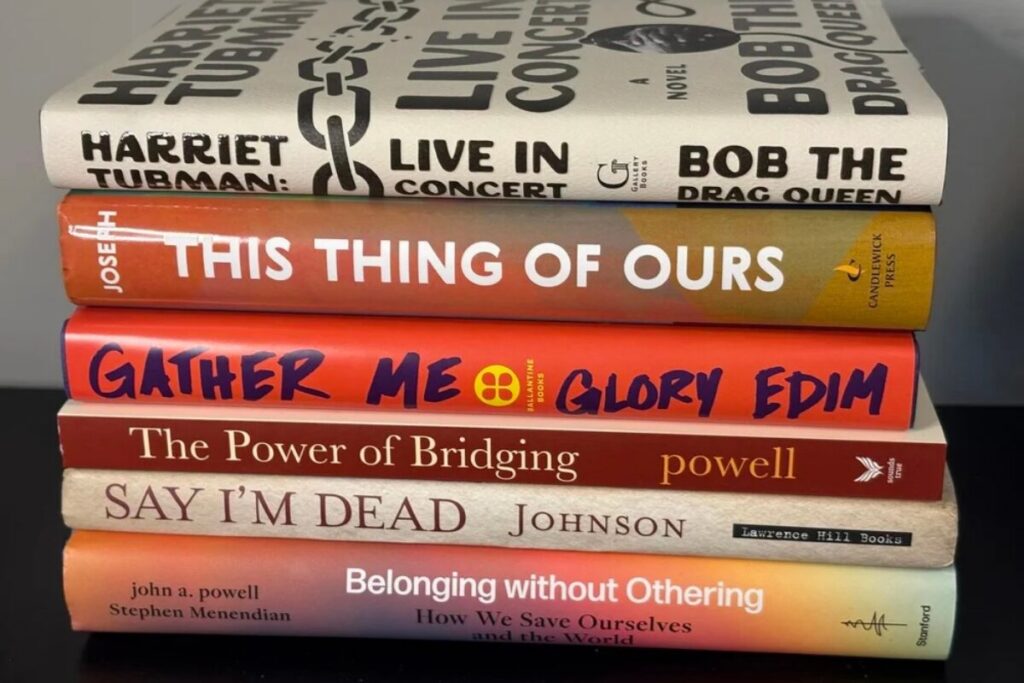
Getting To We Books for 2025
These books for 2025 provide ideas and inspiration to help transform division into connection in everyday life and across communities.
Read More
The Power of Memory Work: Learning from the Germans
Memory work helps societies confront past injustices. Learn how Germany’s approach can inspire reflection, accountability, and growth in our own...
Read More
Let’s Keep Talking About Racism: 10 Tips for How to Do That
Talking about racism is challenging, yet essential. These ten tips provide guidance for continuing conversations in productive, meaningful ways.
Read More
Comments
Comments