
Race, Identity & the Writer's Craft
To My White Friends Who Know Me
Deborah Plummer

I have a lot of White friends. Obviously, they have always known that I am Black. The amount of melanin in my skin hasn’t changed. I haven’t changed in my expression of my Black culture. I still talk the same way, like the same kind of books, movies, plays, art, and enjoy the same kinds of leisure activities. I still care about the same things and react to social issues in the same way. I have always been and remain a strong advocate for racial equity. It’s been my life’s work as a psychologist and Diversity, Equity, Inclusion and Belonging professional. I have always named and worked to eradicate racism in organizations and school systems. I have always called out and continue to call out religious institutions for their racism and their hypocrisy. They have known me to talk about the joys of being Black. They have heard me tell stories of Blacks as a people of deep racial consciousness and high race esteem rooted in agility, creativity, wonder and stamina. They have claimed me as their Black friend.
Yet, during this time of aggressive push for racial equity, most of my White friends are now just seeing and experiencing me as a Black person. Having witnessed a startling, violent 8 minutes and 46 seconds of video, they now see me and other Blacks as the recipients of systemic racism. They understand that the murder of George Floyd represents the weight of how Blacks in the United States have been treated for decades, and they struggle not to see themselves as participants in anything vicariously related to what Derek Chauvin did.
My White friends are now on an emotional roller coaster as they read Isabel Wilkerson’s Caste. They are making personal racial equity to-do lists and signing up for accountability partners after reading Ibram X. Kendi’s How To Be An Antiracist. They take the Antiracist Style Indicator (ASI) and do a happy dance when they yield a functioning antiracist score and post it on their Facebook page with pride. They send me emails of screen shots of their functioning antiracist scores as if it they were winning million dollar lottery tickets. They apologize to me if their ASI results yield a score of a underfunctioning antiracist and share their plan for doing better.
They know, acknowledge, and make no excuses for the fact that Trump is racist and are genuinely horrified by his long history of racism. They know that race is strongly correlated with voting preferences and that the vast majority of Trump supporters are White. They are afraid of the disparate impact on me and other BIPOC if Trump is reelected and are actively working to prevent that from happening.
My White friends are apologizing to me for things they said, might have said, or could have possibly said that did, could have, or might have smacked of racism. They are doing mental rewinds of situations where they showed me support and writing mini memoirs sent to me in emails as proof that they really are and have been antiracist pre-George Floyd. Some of their stories I vividly remember, and some stories I do not recall at all. For example, someone told me she cried in my lap when we were in high school on the day Martin Luther King was shot. I take her word for it. As the only Black student in my class, that day was pretty much a blur for me. She obviously needs to hold on to that memory as a catalyst for being antiracist more than I have a need to refute it.
When I share with my White friends how frustrated and tired I am of White people, they understand and leave me alone. They’ve figured out that they are White and what Whiteness can represent to a Black person during these times. They try to be supportive. Most of the time they are being supportive, but sometimes they miss the mark and say things like, “Please don’t take responsibility for confronting the racism of the world!” They bounce back and practice emotional resilience when I correct them. I tell them that I am not taking responsibility, but that I am dealing with the impact of those who do not take responsibility for racism and those that should take responsibility. In some cases, they even understand that I am referring to them. They thank me and state that they have learned something and the round of apologies start again.
They want to learn, but don’t expect me to teach them. They’ve heard me say countless times that that I can’t do their racial identity resolution work. White friends who know me well and who practice healthy racial identity resolution have courageous conversations with me about race and aren’t afraid to disagree with me. After all, they have known me to be wrong at least a few times in our long friendship and they understand the complexity of racial dynamics and that there can be multiple realities. When I ignore racism or normalize it as “just the way things are,” they call it out. Those are the times when I know that I have more than just an ally. I have a true friend who is White, fighting to denormalize racism.
To my White friends who know me and who are stumbling along the path to achieve racial equity, who are in the ring fighting for racial justice even with one hand tied behind their back and one hand swinging, who go to bed angry over the state of race relations and depressed about any part they may have had in contributing to systemic racism, yet wake up every morning with a vision for a better future and the commitment to make that vision a reality, I share this quote from Richard Rohr:
“The work of solidarity is to close the distance these systems have put between us by joining and accepting others as fully human — in our struggles and gifts alike. This work requires a commitment to relational accompaniment. What is needed, according to Paulo Freire, is for us to ‘stop making pious, sentimental, and individualistic gestures, and risk an act of love.’”
Thank you for these acts of love.
Share


Be Part of the Movement Toward Getting to We.
Be part of a growing movement that uses the arts to build trust, empathy, and shared humanity.
Subscribe to our newsletter for new stories, events, and insights on bridging difference and strengthening connection.
Sign Up
Related Reading
Continue exploring reflections and stories that inspire trust, belonging, and understanding across our shared human experience.
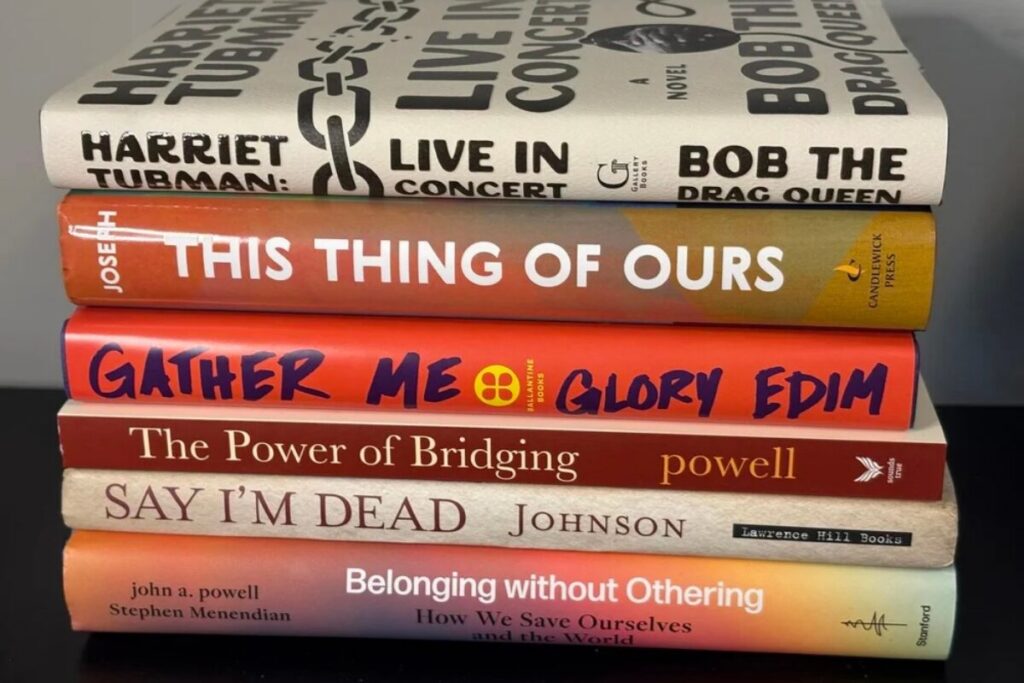
Getting To We Books for 2025
These books for 2025 provide ideas and inspiration to help transform division into connection in everyday life and across communities.
Read More
The Power of Memory Work: Learning from the Germans
Memory work helps societies confront past injustices. Learn how Germany’s approach can inspire reflection, accountability, and growth in our own...
Read More
Let’s Keep Talking About Racism: 10 Tips for How to Do That
Talking about racism is challenging, yet essential. These ten tips provide guidance for continuing conversations in productive, meaningful ways.
Read More
Comments
Comments